
The Deciphering Challenge
Overline
Voices Frozen in Ink:
Unlocking the Handwritten Secrets of Your Ancestors
History is not only preserved in printed textbooks or modern registers – the true, raw stories of your family are locked inside the sweeping curves of Kurrent and the sharp angles of Sütterlin script. To truly discover who your ancestors were, you must look at the original ink they left behind: the deeply personal letters, the detailed church books, the dusty wills, and the official court records that hold the final puzzle pieces of your lineage.
For centuries, these old German handwritings served as the ultimate bridge between generations. However, over decades and across oceans, the ability to read these ancient scripts was slowly lost to time. What remains today are fragile pages filled with mysterious symbols – words that guard the names, the struggles, the heartbreaks, and the triumphs of your forefathers.
Stepping into the world of old German script provides family historians with profound, direct access to the past. Translating a 300-year-old parish record or deciphering a handwritten diary entry reveals the authentic lives your family lived beneath German skies. It transforms cold names and dates into living, breathing family history.
Explore our weekly archive below, where we meticulously analyze original German documents, break down complex historical scripts, and teach you the art of transcription – bringing the forgotten voices of the past back to life with academic precision.
Ready to uncover your family’s full story?
Discover how our tailored transcription services go beyond solving script puzzles, transforming unreadable Kurrent and Sütterlin records into a beautifully curated, readable chronicle.
Part 4:
German ancestors died that day
25.10.2026
This tragic mass entry is recorded in the death register of the parish of Arnstein in Lower Franconia (Bavaria), dated January 15, 1627. Behind the messy, archaic ink lies the raw, unedited history of “The Old Country.”
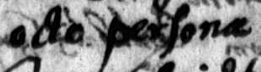
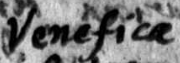
Who died on that fateful day in January 1627?
A) “octo personae Venaticae” (Eight hunting persons)
B) “octo personae Beneficae” (Eight female benefactors)
C) “octo personae Veneficae” (Eight witch-labeled persons)
The correct answer is C
Word-by-word Transcription and Comparision:
“octo personae Veneficae” (Eight witch-labeled persons)
Historical Context and Lore:
The full text reveals that eight individuals were executed by the sword and then burned at the stake (zum Schaidterhauffen) while all the town’s church bells tolled (mit allen klocken geleut). In early modern Germany, priests often switched to Latin Kursive when documenting the grim reality of witch trials. The Latin word “venefica” historically meant “poisoner” or “sorceress” – the standard legal term for alleged witchcraft.
Imagine tracking your lineage back to the 1600s and suddenly stumbling upon a localized mass tragedy like this.
Part 3:
A marriage in 1871 ⠀
15.10.2026
155 years ago Gottfried Wilhelm Carl Wenzel and Auguste Marie Röder got married in Dresden. At 26 years old, the husband had an interesting job. Can you decipher which one?

What was the groom’s job?
A) “Markthelfer in einer Lumpen-fabrik” (Market Helper in a Rag Factory)
B) “Werkführer in einer Lampen-fabrik” (Foreman in a Lamp Factory)
C) “Werkmeister in einer Leder-fabrik” (Master in a Leather Factory)
The correct answer is B
Word-by-word Transcription and Comparision:
“Werkführer in einer Lampen-fabrik” (Foreman in a Lamp Factory)
Historical Context and Lore:
Finding an ancestor designated as a “Werkführer in einer Lampen-fabrik” in Dresden around 1871 places your lineage at the very heartbeat of the European Industrial Revolution. The year 1871 marked the birth of the German Empire and the onset of the “Gründerzeit” – an era of unprecedented economic boom and technological pride.
During this exact time, Dresden became a world-renowned center for the manufacturing of high-end lighting. Factories like the famous “Seidel & Naumann” or the prominent lamp manufacturers in the Dresden-Friedrichstadt district were producing massive quantities of innovative petroleum lamps, gas fixtures, and artistic metal chandeliers that were exported worldwide, heavily including the United States.
A “Werkführer” (Foreman / Shop Floor Manager) was not a simple factory worker. He belonged to the emerging, proud class of highly skilled industrial specialists. Positioned directly between the wealthy factory owners (Fabrikanten) and the ordinary laborers, the Werkführer was responsible for supervising the entire production line, maintaining the complex machinery, and ensuring the absolute precision of the sophisticated brass, glass, and metal components required for cutting-edge lighting technology.
Part 2:
On This Day 215 years ago a marriage happened
08.10.2026 – Early entry, remastering is in progress; updated video version coming soon
In 1811 Michael Ramler and Anna Maria Kerf married on October 8th. The record states that the husband was 32 years old and master woodworker. Besides that, he also was part of the Bavarian military. But what rank had he?

What was Michael Ramler’s rank in the military?
A) “Auditeurmann der National Garde” (Military Judge Advocate of the National Guard)
B) “Oberlieutenant der National Garde” (First Lieutenant of the National Guard)
C) “Obristlieutenant der National Garde” (Lieutenant Colonel of the National Guard)
The correct answer is B
Word-by-word Transcription and Comparision:
“Oberlieutenant der National Garde” (First Lieutenant of the National Guard)
Historical Context and Lore:
In 1811, during the turbulent Napoleonic Era, King Max I Joseph of Bavaria established the “National-Garde”. Michael Ramler served in the 3rd Class (Bürgermilitär) – a local militia of respected citizens and tradesmen formed to protect their own hometown.Because of his high local status, he wasn’t just a soldier; he was elected or appointed as an officer: an Oberlieutenant (First Lieutenant)!
Part 1:
Born on this day in 1812 ⠀
04.09.2026 – Early entry, remastering is in progress; updated video version coming soon
Can you decipher the exact moment a new life began under the German skies in 1812?
This fragile entry records the birth and baptism of Anna Zirngibel. Look closely and test your genealogical skills.
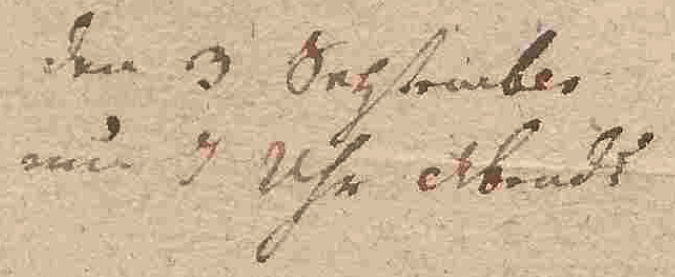
At what time was Maria Zirngibel born?
A) “um 3 Uhr Nacht” (at 3 o’clock in the night)
B) “um 3 Uhr Abends” (at 3 o’clock in the evening)
C) “um 7 Uhr Abends” (at 7 o’clock in the evening)
The correct answer is C
Word-by-word Transcription and Comparision:
Line 1: “den 3 September” (on September 3rd)
Line 2: “um 7 Uhr Abends” (at 7 o’clock in the evening)
Historical Context and Lore:
In early 19th century German church books, recording the exact hour of birth was of profound importance. It was not just an administrative necessity, but deeply rooted in traditional beliefs. Knowing the precise hour allowed families to determine the astronomical and spiritual signs under which a child was born. Furthermore, in cases of weak newborns, knowing the exact time was crucial for the pastor to verify if an emergency baptism (Nottaufe) was performed in time to save the infant’s soul according to Christian doctrine.